


GoSearch vs. Glean GoSearch vs. Glean
For organizations that need live AI answers grounded in company knowledge and predictable pricing at half the cost, GoSearch is the leading Glean alternative for enterprise search, AI chat, specialized agents, and no-code workflows.





What GoSearch does that Glean can't
GoSearch
Hybrid architecture, real-time retrieval
Transparent pricing, roughly 50% the cost
Lean infrastructure footprint, no dedicated FTE
Deploys in days, not months
Free plan and accesible POC options

Glean
Legacy indexed architecture, data latency
Costly, quote-based pricing; high minimums
High infrastructure costs, dedicated FTE
Onboarding spans months with added fees
No free tier; paid POCs
Real results from GoSearch customers
47%
efficiency gain
80%
adoption in 3 months
< 3
months to ROI
Glean runs on a legacy architecture.
GoSearch is the context layer for enterprise AI.
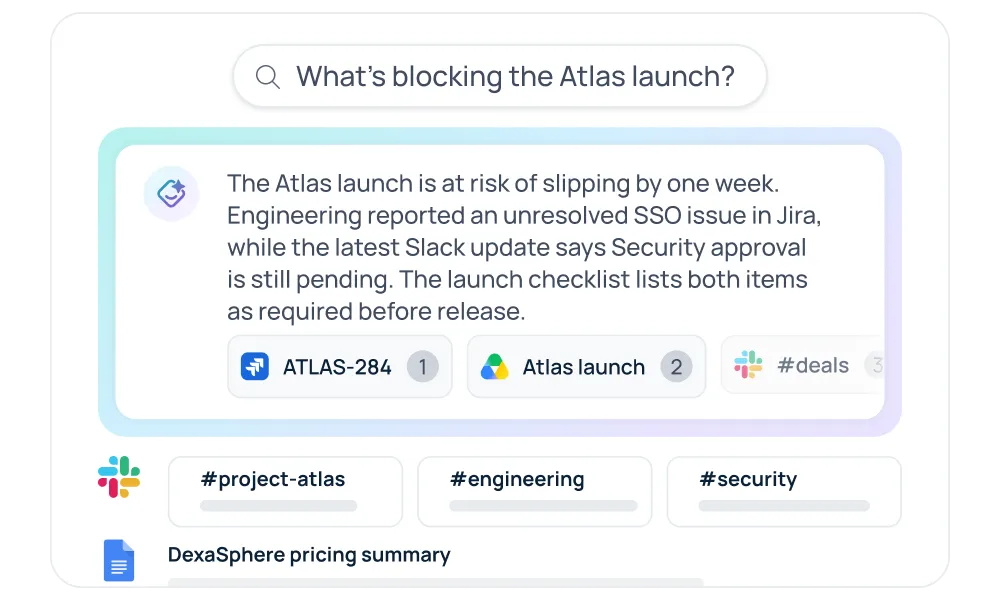
Enterprise search
GoSearch
Built on a hybrid architecture, GoSearch deploys in days. There's no ingestion infrastructure to tune, permissions sync with your source systems, and no dedicated FTE is needed to maintain a data index.
Glean's centralized indexing often takes months to deploy. It requires ongoing ingestion, permission mapping, and relevance tuning, and buyers report dedicating a FTE to maintenance.
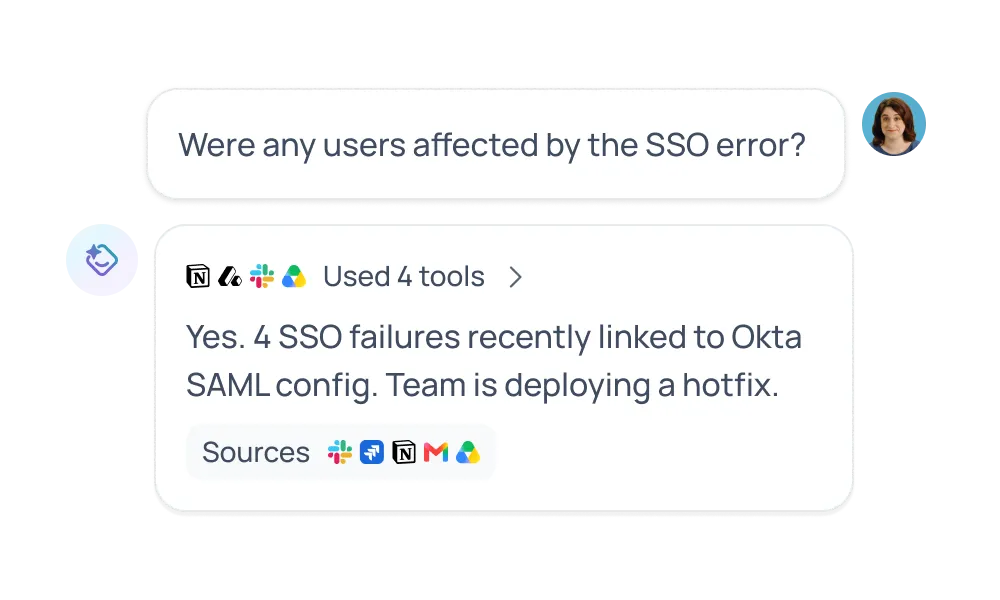
AI chat assistant
GoSearch
GoSearch AI chat retrieves data directly from source systems at query time, so employees can trust that AI responses reflect the current state of the business.
Glean's chat answers are based on indexed data rather than queried live. If recent updates haven't synced yet, employees may need to verify answers before acting on them.
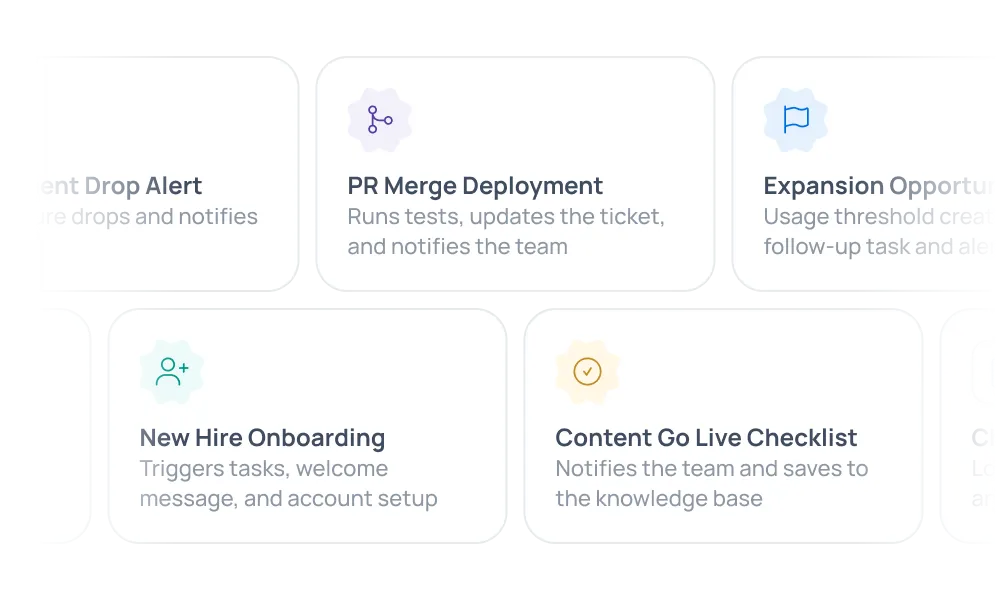
Agents
GoSearch
GoSearch's hybrid knowledge layer powers every AI experience, from search and chat to specialized agents. With no code, any team can create agents grounded in live company context.
Because Glean's agents rely on the same centralized index, they inherit the same data freshness and maintenance tradeoffs as the rest of the platform.
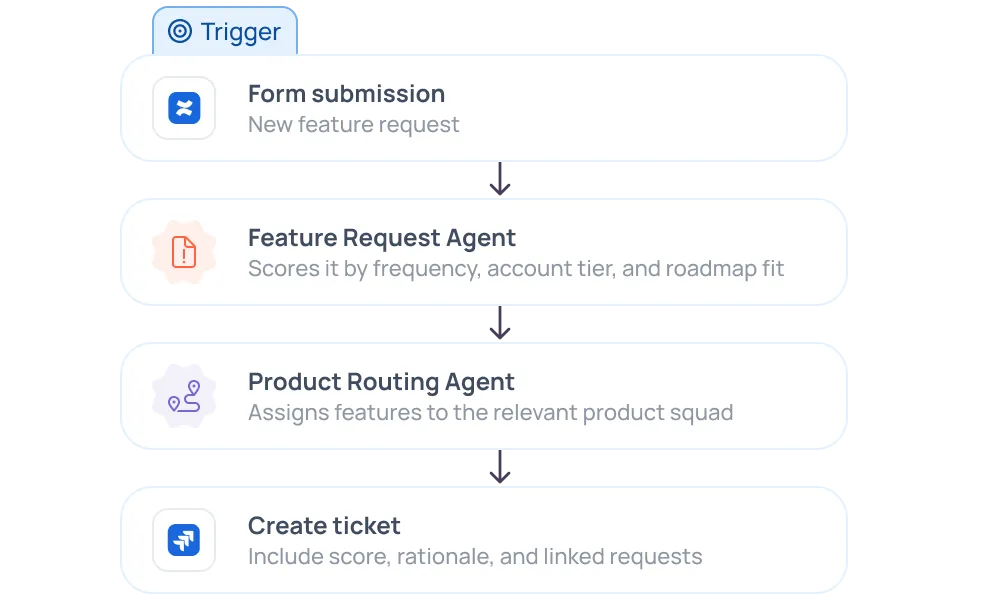
Workflows
GoSearch
GoSearch's workflow builder lets any employee chain specialized agents and apps into a multi-step automation, described in natural language, with no developer involved.
Glean's workflows lean on indexed data, so results can lag behind real changes in source systems. GoSearch's federated approach queries live data at retrieval time, not a stale copy.
Enterprise search
GoSearch
Built on a hybrid architecture, GoSearch deploys in days. There's no ingestion infrastructure to tune, permissions sync with your source systems, and no dedicated FTE is needed to maintain a data index.
Glean's centralized indexing often takes months to deploy. It requires ongoing ingestion, permission mapping, and relevance tuning, and buyers report dedicating a FTE to maintenance.
AI chat assistant
GoSearch
GoSearch AI chat retrieves data directly from source systems at query time, so employees can trust that AI responses reflect the current state of the business.
Glean's chat answers are based on indexed data rather than queried live. If recent updates haven't synced yet, employees may need to verify answers before acting on them.
Agents
GoSearch
GoSearch's hybrid knowledge layer powers every AI experience, from search and chat to specialized agents. With no code, any team can create agents grounded in live company context.
Because Glean's agents rely on the same centralized index, they inherit the same data freshness and maintenance tradeoffs as the rest of the platform.
Workflows
GoSearch
GoSearch's workflow builder lets any employee chain specialized agents and apps into a multi-step automation, described in natural language, with no developer involved.
Glean's workflows lean on indexed data, so results can lag behind real changes in source systems. GoSearch's federated approach queries live data at retrieval time, not a stale copy.
GoSearch vs. Glean

Frequently asked questions
Both GoSearch and Glean are enterprise search and AI agent platforms, but they differ in architecture and pricing. GoSearch retrieves data in real time through a hybrid architecture, so agents, chat, and search all run on live source data without an ingestion pipeline to build or tune. Glean relies on a centralized Knowledge Graph that requires ongoing indexing, permission mapping, and relevance tuning as new sources connect. GoSearch also publishes transparent Free, Pro, and Enterprise pricing, while Glean requires a custom sales quote with a 100-seat minimum and no free tier.
Yes. GoSearch delivers enterprise search, AI chat, agents, and workflow automation on a hybrid architecture that retrieves data in real time, without the ingestion pipelines and tuning Glean's centralized index requires. Paired with transparent Free, Pro, and Enterprise pricing instead of Glean's quote-only, 100-seat-minimum contracts, it's a strong fit for organizations that want live answers and predictable costs.
Typically, yes. Glean's minimum contracts run around $60,000 annually for 100 seats, at roughly $50–75 per user per month, plus infrastructure and admin overhead in BYOC deployments. GoSearch publishes transparent Free, Pro, and Enterprise tiers, making total cost easier to predict and generally 40-50% lower at comparable scale.
GoSearch uses a hybrid model, indexing minimal shared content while retrieving sensitive or fast-changing data live, so there's no ingestion pipeline to build or tune. Glean's centralized Knowledge Graph requires ongoing ingestion, permission mapping, and relevance tuning each time a new source connects, often extending onboarding to months and requiring a dedicated admin resource to maintain.
No. Glean requires a custom sales quote for all plans, with no published price list, no free tier, and typically a 100-seat minimum before a contract begins, and proof-of-concept access is a paid engagement. GoSearch publishes Free, Pro, and Enterprise pricing and offers low-cost or free POC options, so teams can evaluate cost before talking to sales.